
How Amazon KDP Royalties Actually Work (Paperback, Hardcover & eBook Explained)
Complete beginner-to-advanced guide explaining Amazon KDP royalties for all formats. Real examples, printing costs, and why authors get confused.
What Are Amazon KDP Royalties?
When you sell a book through Amazon's Kindle Direct Publishing platform, you don't keep the full sale price. Amazon takes a cut, and for print books, there are manufacturing costs. What remains is your royalty—the money that actually lands in your bank account.
Understanding how these royalties work isn't just academic. It directly affects:
- How you price your books
- Which formats make sense for your content
- Whether a book idea is financially viable
- Your actual income per sale
Let's break down exactly how Amazon calculates what you earn for each format.
Ebook Royalties: The 35% vs 70% Decision
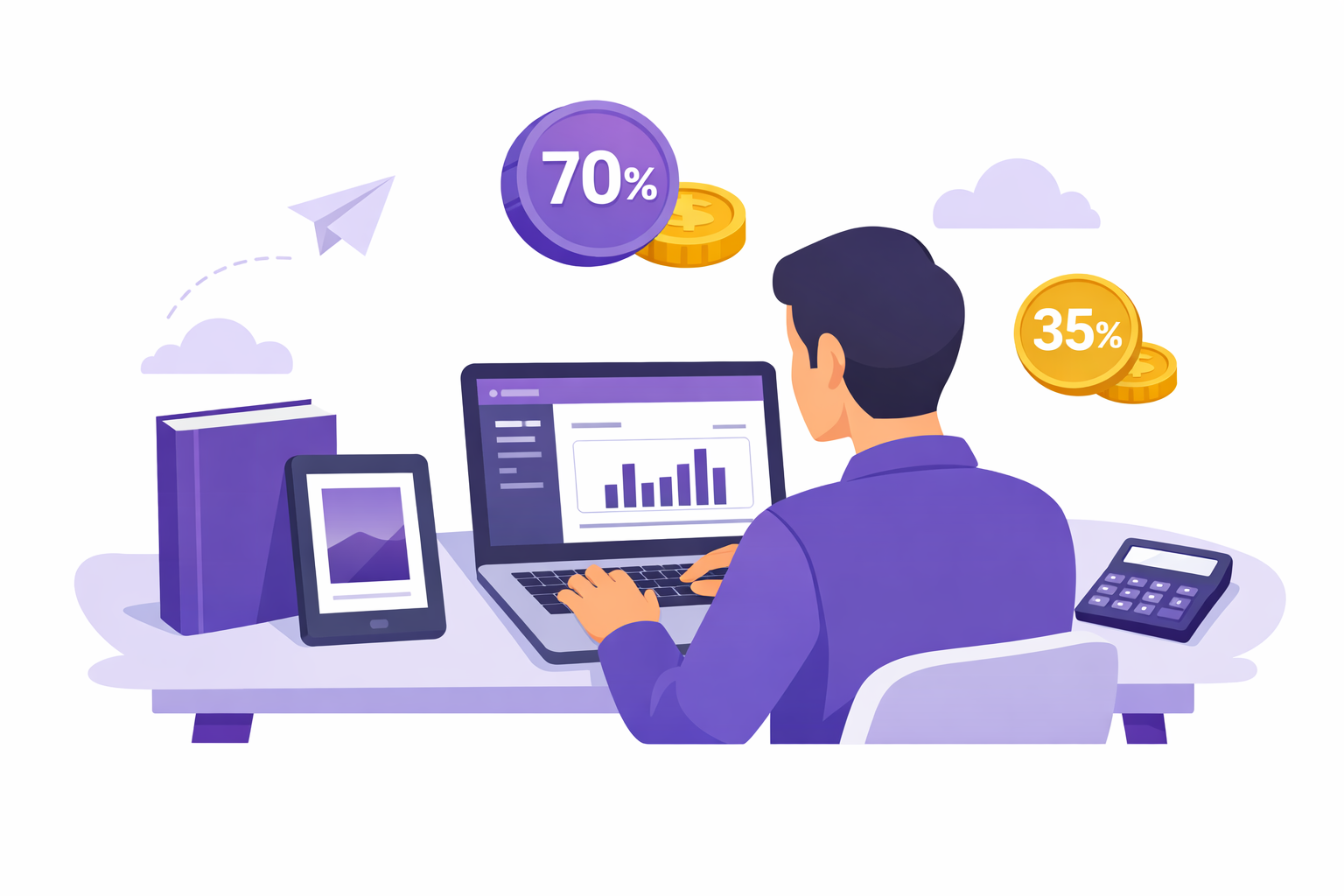
Amazon offers two royalty options for Kindle ebooks. This choice significantly impacts your earnings.
The 70% Royalty Option
Most authors should use this tier. Here's how it works:
Requirements:
- Price between $2.99 and $9.99 USD (or equivalent in other currencies)
- Book must be enrolled in certain Amazon marketplaces
- Price must be at least 20% below the print version (if you have one)
The catch: Amazon subtracts a delivery fee based on your ebook's file size. This fee varies by marketplace:
| Marketplace | Delivery Fee per MB |
|---|---|
| United States | $0.15 |
| United Kingdom | £0.10 |
| Germany | €0.12 |
| Japan | ¥1 |
Real example:
Your novel is priced at $5.99 with a 2MB file size.
- List price: $5.99
- Royalty rate: 70%
- Gross royalty: $5.99 × 0.70 = $4.19
- Delivery fee: 2MB × $0.15 = $0.30
- Your royalty: $3.89 per sale
For text-heavy books, delivery fees are minimal. For image-heavy books like cookbooks or photography collections, they can eat into profits significantly.
The 35% Royalty Option
This tier applies automatically when:
- Your ebook is priced below $2.99 or above $9.99
- Your book contains public domain content
- You're selling in certain international markets
Advantages:
- No delivery fee
- Flexible pricing options
- Works at any price point
Disadvantage:
- You earn less than half compared to 70% on the same price
Real example:
Same novel, but priced at $0.99 as a promotional price:
- List price: $0.99
- Royalty rate: 35%
- Your royalty: $0.35 per sale
Compare that to pricing at $2.99:
- List price: $2.99
- Royalty rate: 70%
- Delivery fee: ~$0.30
- Your royalty: ~$1.79 per sale
You'd need to sell over 5x more copies at $0.99 to match the earnings from $2.99. This is why pricing strategy matters.
Paperback Royalties: Understanding the Formula
Paperback royalties work completely differently from ebooks. There's a manufacturing cost that comes out before you see a penny.
The Basic Formula
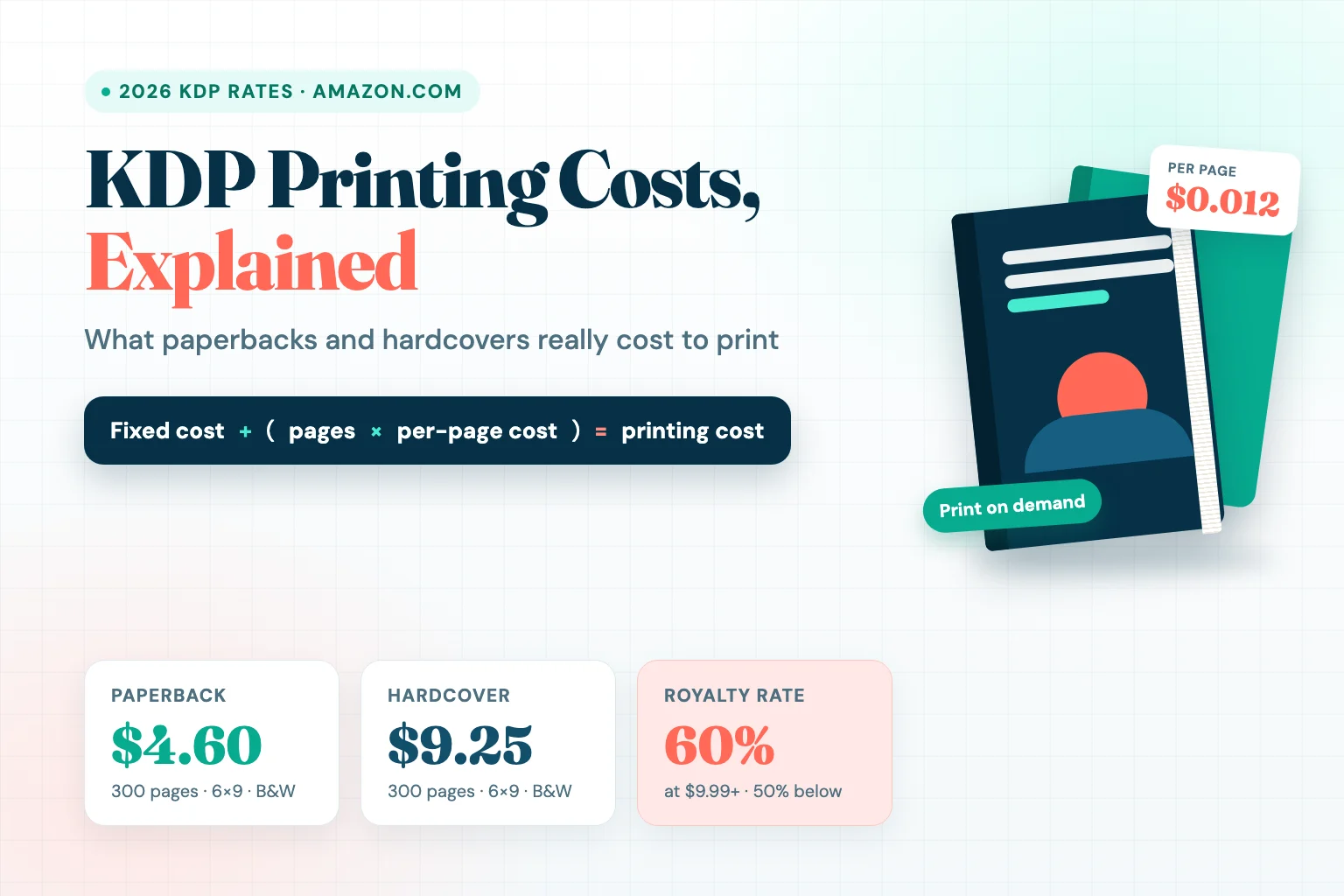
Your paperback royalty = (List Price × Royalty Rate) - Printing Cost
The royalty rate for paperbacks is 60% of the list price.
What Determines Printing Cost?
Amazon's printing cost depends on several factors:
1. Page count: More pages = higher cost
2. Interior type:
- Black & white ink (cheapest)
- Standard color
- Premium color (most expensive)
3. Trim size:
- Standard sizes (6×9, 5.5×8.5) cost less
- Larger formats cost more
4. Marketplace: Printing costs vary by country
Real Paperback Examples
Example 1: Fiction novel
- 250 pages, black & white, 6×9 trim
- List price: $14.99
- Printing cost: ~$4.05
Calculation:
- Gross royalty: $14.99 × 0.60 = $8.99
- Minus printing: $8.99 - $4.05 = $4.94 per sale
Example 2: Children's picture book
- 32 pages, premium color, 8.5×8.5 trim
- List price: $12.99
- Printing cost: ~$5.85
Calculation:
- Gross royalty: $12.99 × 0.60 = $7.79
- Minus printing: $7.79 - $5.85 = $1.94 per sale
Example 3: Cookbook
- 150 pages, standard color, 8×10 trim
- List price: $24.99
- Printing cost: ~$9.50
Calculation:
- Gross royalty: $24.99 × 0.60 = $14.99
- Minus printing: $14.99 - $9.50 = $5.49 per sale
Notice how page count and color dramatically affect your margins. This is why pricing a children's book too low can result in zero or even negative royalties.
Hardcover Royalties: Premium Format, Different Rules
Hardcover books through KDP work similarly to paperbacks, but with some key differences.
Hardcover Royalty Formula
Your hardcover royalty = (List Price × Royalty Rate) - Printing Cost
The royalty rate for hardcovers is 50% of the list price (compared to 60% for paperbacks).
Higher Printing Costs
Hardcovers cost more to manufacture. A book that costs $4.00 to print as a paperback might cost $8.00+ as a hardcover.
Limited Marketplace Availability
Hardcovers aren't available in all Amazon marketplaces. As of now, they're primarily available in:
- United States
- United Kingdom
- Germany
- Poland
- Sweden
If you're targeting readers in Canada, Australia, or Japan, hardcover isn't currently an option through KDP.
Real Hardcover Example
Business book:
- 200 pages, black & white, 6×9 trim
- List price: $29.99
- Printing cost: ~$9.80
Calculation:
- Gross royalty: $29.99 × 0.50 = $15.00
- Minus printing: $15.00 - $9.80 = $5.20 per sale
Compare to paperback version at $17.99:
- Gross royalty: $17.99 × 0.60 = $10.79
- Minus printing: $10.79 - $4.05 = $6.74 per sale
Despite the higher list price, the paperback earns more per sale. However, hardcovers can attract different buyers willing to pay premium prices, and some readers simply prefer the format.
Why Authors Get Confused About Royalties
These are the points authors most often get confused about.
Confusion #1: Thinking 70% means keeping 70%
For ebooks, the delivery fee comes out after the percentage calculation. For a $4.99 ebook with a large file size, you might only keep 60-65% in practice.
Confusion #2: Not accounting for printing costs
Many new authors price their paperback at $9.99 and wonder why their royalty is only $0.50. The printing cost is a fixed expense that doesn't scale with your price.
Critical rule: Your list price must be high enough that after the 60% royalty rate AND printing costs, you still earn something. Price too low, and you earn nothing or even lose money.
Confusion #3: Expanded distribution math
When you enable expanded distribution (selling through bookstores and libraries), your royalty rate drops to 40% instead of 60%. Many authors enable this feature without realizing their per-book earnings drop significantly.
Confusion #4: Currency confusion
If you're pricing in pounds, euros, or yen, the minimum and maximum prices for the 70% ebook tier are different. Authors often accidentally price themselves into the 35% tier without realizing it.
Confusion #5: Forgetting about Amazon's price matching
If Amazon finds your ebook cheaper elsewhere (your website, another retailer), they may match that lower price. Your royalty is calculated on the matched price, not your intended list price.
Calculating Your Exact KDP Royalties Instantly
Running these calculations manually for every book, format, and marketplace combination is tedious and error-prone.
That's exactly why we built the Amazon KDP Royalty Calculator.
What Our Calculator Does
- Instant results: Enter your details, see your royalties immediately
- All formats: Ebook, paperback, and hardcover calculations
- Real printing costs: Uses Amazon's actual December 2025 pricing data
- Multiple marketplaces: Calculate earnings across US, UK, Germany, and more
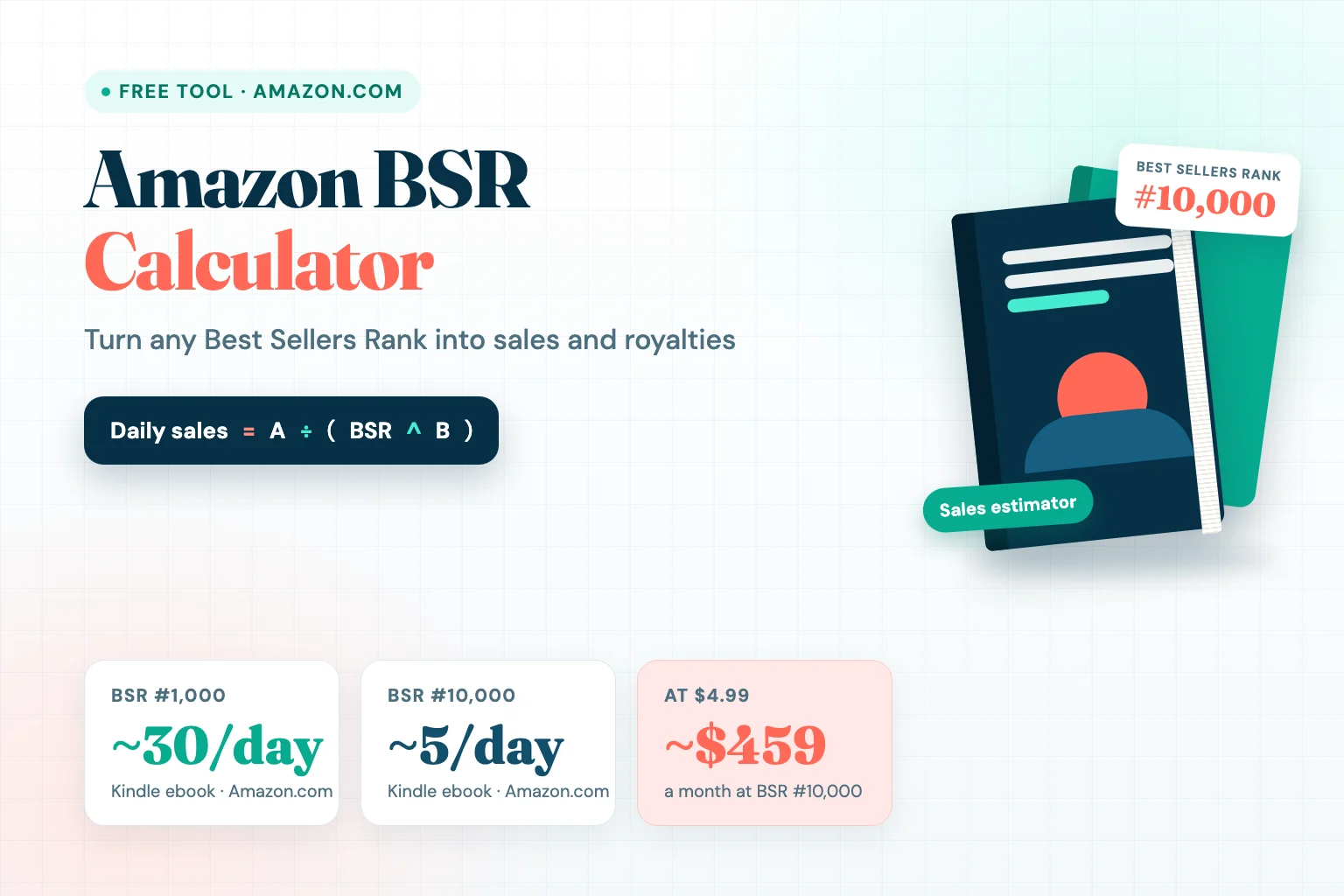
- BSR estimates: Convert sales rank to estimated daily sales
- Both royalty tiers: See 70% and 35% scenarios side by side
How to Use It
- Select your marketplace (US, UK, DE, etc.)
- Choose your format (ebook, paperback, hardcover)
- Enter your list price
- For ebooks: add your file size
- For print books: enter page count and select interior type
The calculator instantly shows:
- Your royalty per sale
- Estimated daily and monthly earnings (if you enter BSR)
- Printing costs for print formats
- Delivery fees for ebooks
👉 Calculate your real Amazon KDP royalties here — know your numbers before you publish.
Pricing Strategy Tips Based on Royalties
Understanding royalties helps you price smarter.
Ebook Pricing Sweet Spots
- $2.99: Minimum for 70% tier. Good for shorter books or series starters.
- $3.99-$4.99: Popular range for most fiction and niche non-fiction.
- $5.99-$7.99: Standard for full-length novels and comprehensive guides.
- $9.99: Maximum for 70% tier. Works for premium content.
Paperback Pricing Guidelines
Calculate your minimum viable price:
- Look up your printing cost (use our royalty calculator)
- Divide by 0.60 to find breakeven
- Add your desired profit margin
Example: $4.05 printing cost ÷ 0.60 = $6.75 breakeven. For a $3 profit, price at $11.75 or higher.
When Low Prices Make Sense
Sometimes low royalties are strategic:
- Series starters: Price book 1 at $0.99 or free to hook readers
- Building reviews: Lower price = more sales = more reviews
- Promotional periods: Temporary price drops for visibility
Just run the numbers first so you know what you're trading off.
Real-World Royalty Scenarios
Let's look at complete scenarios across all formats.
Scenario 1: Self-Help Book Author
Ebook: $7.99, 1.5MB file
- Royalty: ($7.99 × 0.70) - $0.23 = $5.36
Paperback: 180 pages, B&W, $15.99
- Royalty: ($15.99 × 0.60) - $3.72 = $5.87
Hardcover: Same specs, $27.99
- Royalty: ($27.99 × 0.50) - $8.40 = $5.60
Monthly at 100 total sales (50 ebook, 40 paperback, 10 hardcover):
- Ebook: $268
- Paperback: $234.80
- Hardcover: $56
- Total: $558.80/month
Scenario 2: Children's Book Author
Ebook: $4.99, 15MB file (lots of images)
- Royalty: ($4.99 × 0.70) - $2.25 = $1.24
Paperback: 32 pages, premium color, $14.99
- Royalty: ($14.99 × 0.60) - $5.85 = $3.14
The high delivery fee for the image-heavy ebook and premium color printing costs show why children's book authors often focus primarily on print sales.
Scenario 3: Low-Content Book Publisher
Paperback journal: 120 pages, B&W, $8.99
- Royalty: ($8.99 × 0.60) - $2.67 = $2.72
At 200 sales per month across a catalog of 20 journals:
- Total: $544/month
Low-content books have lower margins but can scale with volume. Check out our coloring book niches if you're exploring this model.
Frequently Asked Questions
How much does Amazon KDP pay per book?
It depends entirely on format, price, and printing specs. For ebooks priced at $4.99, expect roughly $3.20-$3.40 per sale. For paperbacks, subtract printing costs from 60% of your list price—a $14.99 paperback might earn you $4-5 per sale. Use our KDP royalty calculator to get exact numbers for your specific book.
How much do authors really make on KDP?
According to author surveys, the median self-published author earns under $1,000 per year. However, the top 10% earn $10,000+ annually, and consistent publishers with multiple titles can earn full-time incomes. Your earnings depend on book count, marketing, genre selection, and publishing frequency. Read more in our guide on average Amazon KDP income.
Which royalty option should I choose for ebooks?
For most authors, the 70% option is better when your book qualifies (priced $2.99-$9.99). You'd need to sell 2-5x more copies at 35% to match the same earnings. Only use 35% when necessary for pricing strategy or when you don't qualify for 70%.
Why is my paperback royalty so low?
Printing costs are likely eating into your margins. Check if you're using color interiors (expensive) or have a high page count. Also verify your price is high enough—many authors underprice paperbacks. Use our calculator to see your exact printing cost and find your minimum viable price.
Do hardcovers earn more than paperbacks?
Not necessarily. Hardcovers have a lower royalty rate (50% vs 60%) and higher printing costs. The higher list price can offset this, but per-book royalties are often similar or lower than paperbacks. The advantage is reaching readers who prefer the premium format.
How does expanded distribution affect royalties?
Expanded distribution lowers your royalty rate from 60% to 40% on those sales. This means significantly less per book, so price accordingly. Many authors skip expanded distribution because the margins are too thin.
When do I get paid by Amazon?
Amazon pays approximately 60 days after the end of each month. Sales in January are paid in late March, for example. Payments are made via direct deposit once you reach the minimum threshold ($10 in most marketplaces).
The Bottom Line
Amazon KDP royalties aren't complicated once you understand the formulas:
- Ebooks: (List Price × Royalty Rate) - Delivery Fee
- Paperbacks: (List Price × 60%) - Printing Cost
- Hardcovers: (List Price × 50%) - Printing Cost
The key is running the numbers before you publish, not after. Know your per-book royalty, price accordingly, and make informed decisions about formats and marketplaces.
📊 Calculate your exact KDP royalties now — every successful author knows their numbers.
Related Reading
Topics
Ready to Run the Numbers?
Put this knowledge into action. Calculate your potential royalties before you publish.