
Amazon KDP vs IngramSpark: Which Print-on-Demand Platform Is Better?
A comprehensive comparison of Amazon KDP and IngramSpark covering royalties, distribution, print quality, and which platform suits different publishing goals.
The Two Giants of Self-Publishing
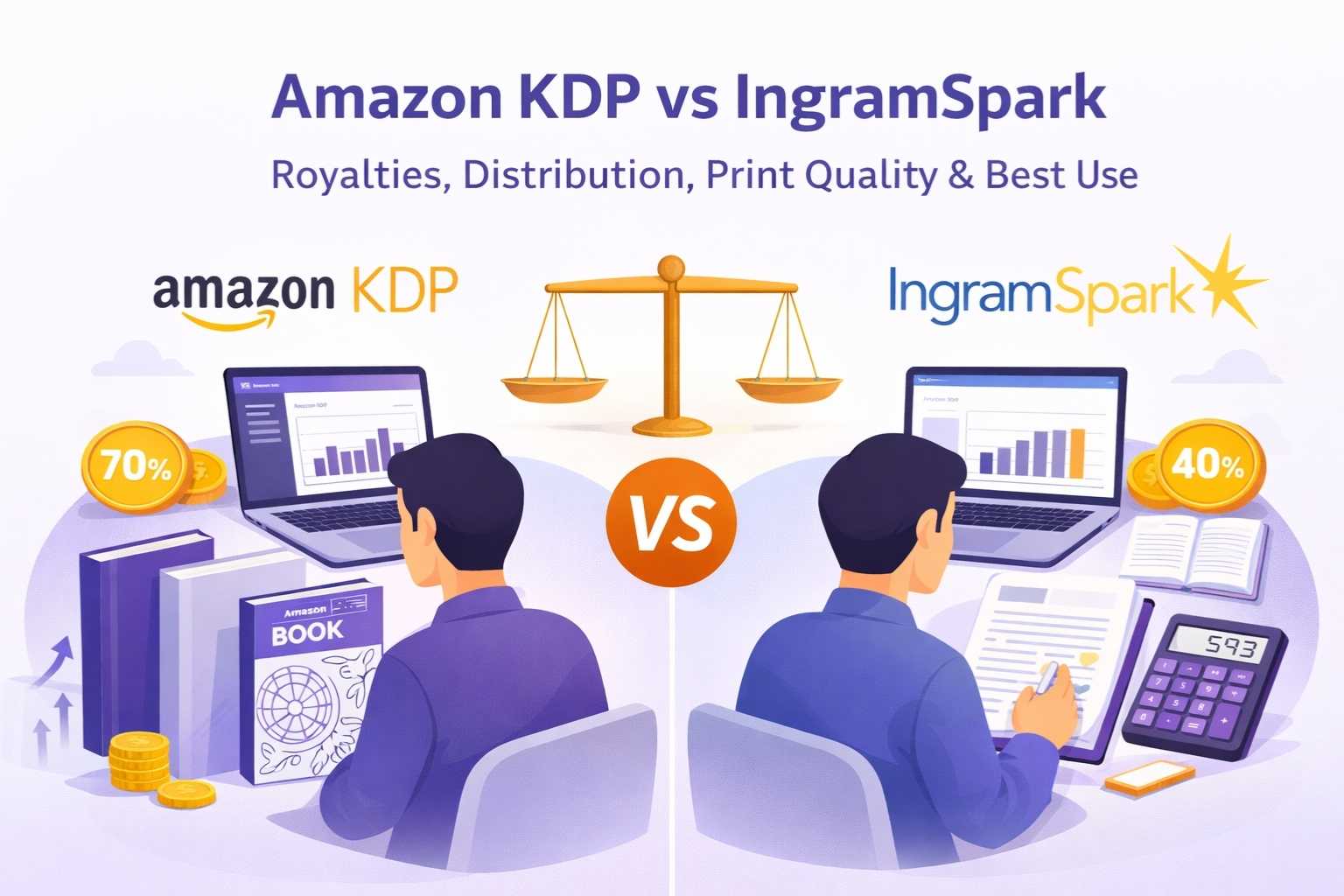
If you're serious about self-publishing, you've likely encountered two major print-on-demand platforms: Amazon Kindle Direct Publishing (KDP) and IngramSpark. Both enable authors to publish and distribute books without upfront inventory costs—but they serve different purposes and come with distinct trade-offs.
This guide breaks down the key differences in royalties, distribution, costs, and features to help you decide which platform (or combination) is right for your publishing business.
Quick Comparison Overview
Before diving deep, here's a side-by-side snapshot:
| Feature | Amazon KDP | IngramSpark |
|---|---|---|
| Setup Cost | Free | Free (waived as of 2023) |
| Print Quality | Good | Excellent |
| Distribution | Amazon only | 40,000+ retailers worldwide |
| Royalty Rate | 60% (paperback) | 55% minus printing |
| Ebook Royalties | 35% or 70% | N/A (print only) |
| Hardcover | Yes (limited) | Yes (full options) |
| Returns | Not applicable | Optional (at your cost) |
| Author Copies | At cost + shipping | At cost + shipping |
| Best For | Amazon-focused sales | Wide distribution |
Understanding the Platforms
What Is Amazon KDP?
Amazon Kindle Direct Publishing is Amazon's self-publishing arm. It handles both ebooks and paperbacks (and now hardcovers), with books printed on-demand and sold exclusively through Amazon's marketplace.
Key characteristics:
- Free to use with no setup or annual fees
- Ebooks and print books in one dashboard
- Global reach across Amazon's marketplaces (US, UK, Germany, Japan, etc.)
- Integrated with Kindle Unlimited for ebook subscription revenue
- Fast publishing (books go live within 24–72 hours)
What Is IngramSpark?
IngramSpark is Ingram Content Group's self-publishing platform. Ingram is the world's largest book distributor, supplying to bookstores, libraries, and online retailers globally.
Key characteristics:
- Free setup (setup fees eliminated in 2023)
- Print-only platform (no ebook distribution)
- Access to 40,000+ retailers including Barnes & Noble, independent bookstores, and libraries
- Industry-standard distribution that bookstores recognize and trust
- Professional-grade print quality with more trim sizes and binding options
Royalties: The Numbers That Matter
Let's break down what you actually earn on each platform.
Amazon KDP Paperback Royalties
KDP offers a 60% royalty rate on paperbacks. Your royalty is calculated as:
(List Price × 60%) − Printing Cost = Your Royalty
Example: A 200-page paperback priced at $14.99:
| Component | Amount |
|---|---|
| List Price | $14.99 |
| Gross Royalty (60%) | $8.99 |
| Printing Cost | $4.25 |
| Net Royalty | $4.74 |
👉 Calculate your exact KDP royalties with our free calculator.
IngramSpark Royalties
IngramSpark uses a different model. You set a wholesale discount (typically 55% for bookstore distribution), and your royalty is:
(List Price × (100% − Discount)) − Printing Cost = Your Royalty
Example: Same 200-page paperback at $14.99 with 55% discount:
| Component | Amount |
|---|---|
| List Price | $14.99 |
| Publisher Compensation (45%) | $6.75 |
| Printing Cost | $4.50 |
| Net Royalty | $2.25 |
Why the lower royalty? That 55% discount goes to retailers (bookstores, libraries) as their margin—this is why they're willing to stock your book.
Royalty Comparison Table
| Book Price | KDP Royalty | IngramSpark (55% discount) | IngramSpark (40% discount) |
|---|---|---|---|
| $9.99 | $2.74 | $0.49 | $1.49 |
| $12.99 | $4.54 | $1.34 | $2.79 |
| $14.99 | $5.74 | $2.25 | $3.99 |
| $19.99 | $8.74 | $4.49 | $6.99 |
Assumes 200-page paperback. Printing costs vary slightly between platforms.
Key insight: KDP pays significantly higher royalties. But IngramSpark opens doors that KDP cannot.
Distribution: Where Will Your Book Sell?
Amazon KDP Distribution
KDP books are sold exclusively on Amazon. This includes:
- Amazon.com (US)
- Amazon.co.uk (UK)
- Amazon.de (Germany)
- Amazon.fr (France)
- Amazon.es (Spain)
- Amazon.it (Italy)
- Amazon.co.jp (Japan)
- Amazon.ca (Canada)
- Amazon.com.au (Australia)
- Amazon.com.br (Brazil)
- Amazon.com.mx (Mexico)
- Amazon.nl (Netherlands)
- Amazon.pl (Poland)
- Amazon.se (Sweden)
While Amazon accounts for roughly 50–70% of all book sales in the US, you're missing the rest of the market.
Expanded distribution note: KDP offers "Expanded Distribution" which theoretically makes books available elsewhere. In practice, this feature is unreliable, comes with even lower royalties, and is not recommended.
IngramSpark Distribution
IngramSpark connects you to:
- 40,000+ retailers worldwide
- Barnes & Noble (online and physical stores)
- Independent bookstores (thousands of them)
- Libraries (public and academic)
- International retailers (Waterstones, Book Depository, etc.)
- Online retailers (beyond Amazon)
Why bookstores matter: If you want your book in physical bookstores, you need IngramSpark. Bookstores don't order from Amazon—they order from Ingram.
Library sales: Libraries almost exclusively order through Ingram. If library distribution matters to your strategy, IngramSpark is essential.
Print Quality Comparison
Amazon KDP Print Quality
KDP print quality is good—not exceptional. It's improved significantly over the years and is perfectly acceptable for most readers.
Characteristics:
- Standard paper quality
- Limited trim sizes (6 paperback sizes)
- Cover finish: matte or glossy
- Binding: perfect bound only
- Hardcover: available but limited options
IngramSpark Print Quality
IngramSpark is often considered superior in print quality—and industry professionals notice the difference.
Characteristics:
- Higher paper quality options
- 30+ trim sizes available
- Premium cover finishes
- Binding options: perfect bound, case laminate, hardcover dust jacket
- Better color reproduction (for illustrated books)
For children's books, coffee table books, or any visually-driven content, IngramSpark's quality advantage becomes significant.
Costs Breakdown
Amazon KDP Costs
| Item | Cost |
|---|---|
| Setup | Free |
| ISBN | Free (Amazon-assigned) or use your own |
| Cover changes | Free |
| Interior changes | Free |
| Author copies | Printing cost + shipping |
KDP is completely free to use. You can make unlimited changes at no cost.
IngramSpark Costs
| Item | Cost |
|---|---|
| Setup | Free (previously $49) |
| ISBN | $85 (single) or $295 (pack of 10) via Bowker |
| Cover/Interior changes | $25 per revision |
| Author copies | Printing cost + shipping |
| Returns | Your cost if enabled |
The revision fee is notable. Unlike KDP, IngramSpark charges $25 every time you update your cover or interior file. This adds up if you're iterating.
ISBN consideration: IngramSpark requires your own ISBN (you can purchase from Bowker or use a free one if available in your country). KDP provides free ISBNs, but they identify Amazon as the publisher.
Ebook Publishing
Amazon KDP: Handles ebook publishing with 35% or 70% royalty options. Integrates with Kindle Unlimited for subscription revenue.
IngramSpark: Does not distribute ebooks. You'll need a separate platform (like Draft2Digital, Smashwords, or direct retailer uploads) for ebook distribution.
Practical approach: Most authors use KDP for ebooks regardless of their print strategy.
The Hybrid Strategy: Using Both Platforms
Many successful self-publishers use both KDP and IngramSpark together. Here's how:
Option 1: Different ISBNs, Full Distribution
- Publish on KDP with a KDP-assigned ISBN for Amazon sales
- Publish on IngramSpark with your own ISBN for everywhere else
This maximizes distribution but requires managing two versions.
Option 2: IngramSpark Primary, KDP Ebooks
- Publish print books on IngramSpark (including Amazon distribution via Ingram)
- Publish ebooks on KDP exclusively
This gives you one ISBN for print and professional distribution, but you may earn slightly less on Amazon print sales.
Option 3: KDP Primary, IngramSpark for Libraries/Bookstores
- Use KDP for the bulk of your sales (Amazon)
- Use IngramSpark specifically for library and bookstore orders
This is practical if you don't want to maintain two versions but need limited wide distribution.
When to Choose Amazon KDP
Choose KDP if:
- ✅ Your primary audience shops on Amazon
- ✅ You want maximum royalties per sale
- ✅ You're publishing ebooks alongside print
- ✅ You want zero upfront costs
- ✅ You need fast, free revisions to your files
- ✅ You're focused on low-content or coloring books (high volume, lower margins)
- ✅ You want access to Kindle Unlimited for ebook subscription revenue
When to Choose IngramSpark
Choose IngramSpark if:
- ✅ You want books in physical bookstores
- ✅ Library sales are part of your strategy
- ✅ You need premium print quality (illustrated books, coffee table books)
- ✅ You want hardcover options with dust jackets
- ✅ You're building a professional author brand
- ✅ You need true global distribution beyond Amazon
- ✅ You're publishing high-content, professional non-fiction
Honest Pros and Cons Summary
Amazon KDP
Pros:
- Free to use, no revision fees
- Higher royalties on Amazon sales
- Integrated ebook + print publishing
- Fast setup (24–72 hours)
- Access to Kindle Unlimited
Cons:
- Limited to Amazon distribution
- Lower perceived "legitimacy" in traditional publishing circles
- Fewer trim sizes and binding options
- Print quality is good but not premium
IngramSpark
Pros:
- Access to 40,000+ retailers worldwide
- Bookstores and libraries will actually order your book
- Superior print quality and more options
- Industry-standard distribution (taken seriously by bookstores)
Cons:
- Lower royalties due to wholesale discounts
- $25 revision fee adds up
- No ebook distribution
- Returns can eat into profits if enabled
Calculate Before You Decide
Your specific book—page count, trim size, and target price—will determine your royalty on each platform. Don't guess.
👉 Use our KDP Royalty Calculator to model your paperback and ebook earnings before making your decision.
The Bottom Line
There's no universally "better" platform—only the better choice for your goals.
- Maximize per-sale profit on Amazon? → Use KDP
- Get into bookstores and libraries? → Use IngramSpark
- Want both? → Use a hybrid strategy with both platforms
Many successful indie authors use KDP for ebooks and Amazon paperback sales while leveraging IngramSpark for wide print distribution. This gives them the best of both worlds.
Start by calculating your potential earnings on each platform, then choose the strategy that aligns with your publishing business goals.
Frequently Asked Questions
Can I use both KDP and IngramSpark for the same book?
Yes, but you'll need different ISBNs for each version (or use KDP's free ISBN for Amazon and your own ISBN for IngramSpark). Many authors do this to maximize distribution.
Which platform has better print quality?
IngramSpark generally offers superior print quality with more paper options, trim sizes, and binding choices. KDP's quality is good but more standardized.
Why are IngramSpark royalties lower?
The wholesale discount (typically 55%) goes to retailers as their profit margin. This is what incentivizes bookstores and libraries to stock your book.
Do bookstores actually order from IngramSpark?
Yes. Bookstores routinely order from Ingram—it's the industry standard. They rarely, if ever, order from Amazon.
Is IngramSpark worth the lower royalty?
It depends on your goals. If bookstore and library distribution matters to you, the lower per-sale royalty is the cost of access. For Amazon-only sales, KDP pays more.
Can I publish ebooks on IngramSpark?
No. IngramSpark is print-only. Most authors use KDP, Draft2Digital, or direct uploads for ebook distribution.
Which is better for low-content books like journals?
KDP is typically better for low-content books due to higher royalties and easier bulk publishing. Bookstore distribution is less critical for journals and planners.
📊 Before you publish, run the numbers with our free KDP royalty calculator.
Topics
Ready to Run the Numbers?
Put this knowledge into action. Calculate your potential royalties before you publish.