
How Many Books Does a #1 Amazon Bestseller Really Sell?
Discover the truth behind Amazon bestseller badges. Learn how BSR works, what sales numbers actually look like, and how to estimate any book's sales.
The #1 Bestseller Mystery
You've seen it everywhere. That orange "#1 Best Seller" badge on Amazon book listings. It looks impressive. Authors plaster it across their social media. Readers assume it means millions of copies sold.
But here's the thing most people don't realize: that badge might represent just 10 sales in a single day.
I'm not exaggerating. The gap between what people think bestseller means and what it actually means is one of the biggest misconceptions in publishing.
Let's break down exactly how this works.
What Is Amazon BSR (Best Sellers Rank)?
Every product on Amazon has a Best Sellers Rank, or BSR. For books, this number appears in the product details and tells you how well that book is selling relative to other books.
Here's the key insight:
- BSR #1 means that book is currently outselling every other book in that category
- BSR #100,000 means roughly 99,999 books are selling better right now
The lower the number, the better the sales. Simple enough.
But here's where it gets interesting.
BSR Updates Hourly
Amazon recalculates BSR approximately every hour. A single sale can dramatically shift your rank, especially if you're currently ranked above 100,000.
This means:
- Your BSR at 9 AM might be completely different from 3 PM
- A burst of sales creates a temporary spike
- Rankings are extremely volatile for most books
Category vs. Overall Rankings
Books have two types of rankings:
Overall Kindle Store / Books rank: Your position among ALL books on Amazon. This is the big number.
Category rank: Your position within specific subcategories. This is where the #1 badges come from.
And here's the crucial distinction that confuses everyone:
You can be #1 in a small subcategory while ranked #50,000 overall. That #1 badge doesn't mean what most people think it means.
The Truth About #1 Bestseller Badges
Let me be direct: most #1 bestseller badges are nearly meaningless.
Amazon has thousands of book subcategories. Some are incredibly competitive (Romance, Thriller, Business). Others have so little competition that selling 5 copies in a day could make you #1.
How Authors Game the System
This isn't a secret in publishing circles. Many authors specifically:
- Choose obscure subcategories with minimal competition
- Launch with coordinated sales on a single day
- Screenshot the #1 badge before it disappears
- Use that screenshot forever in marketing
Is this dishonest? That's debatable. But it means you should take bestseller claims with serious skepticism.
Real #1 Rankings vs. Category #1
There's a massive difference between:
-
#1 in Kindle Store overall: This author is selling thousands of copies daily. We're talking major success, often backed by traditional publishing or massive marketing.
-
#1 in "Books > Arts & Photography > Decorative Arts & Design > Interior & Home Design > Feng Shui": This might represent 3 sales that day.
Both get the same orange badge. Both authors can technically claim "Amazon #1 Bestseller."
See the problem?
How BSR Translates to Actual Sales
Now let's get to the numbers you actually care about.
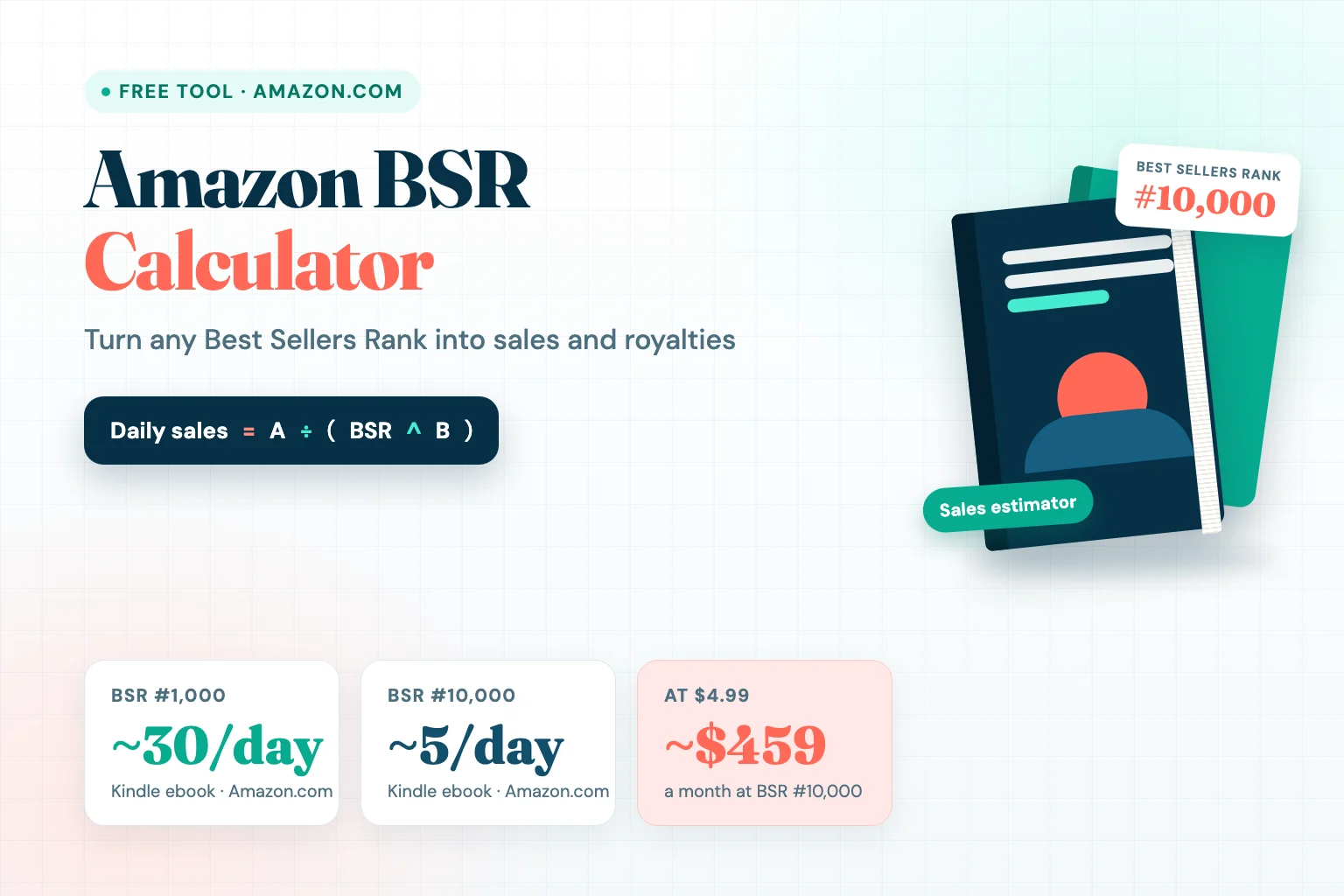
The relationship between BSR and daily sales follows a power law. Sales drop off quickly as rank increases. Here's approximately what different BSR ranges mean:
Amazon Kindle Store (US) - Estimated Daily Sales
| BSR Range | Estimated Daily Sales | Monthly Sales |
|---|---|---|
| #1-5 | 2,000-5,000+ copies | 60,000-150,000+ |
| #6-20 | 500-2,000 copies | 15,000-60,000 |
| #21-100 | 100-500 copies | 3,000-15,000 |
| #101-500 | 40-100 copies | 1,200-3,000 |
| #501-2,000 | 15-40 copies | 450-1,200 |
| #2,001-5,000 | 7-15 copies | 210-450 |
| #5,001-10,000 | 4-7 copies | 120-210 |
| #10,001-50,000 | 1-4 copies | 30-120 |
| #50,001-100,000 | 0.5-1 copy | 15-30 |
| #100,001+ | Less than 1/day | Under 15 |
These numbers fluctuate based on seasonality, category, and market conditions. But they give you a realistic framework.
Paperback Sales Are Different
Print books typically need more sales to achieve the same BSR as ebooks. The print market is smaller overall, but competition varies significantly by category.
| BSR Range (Print) | Estimated Daily Sales |
|---|---|
| #1-100 | 100+ copies |
| #101-1,000 | 25-100 copies |
| #1,001-10,000 | 5-25 copies |
| #10,001-50,000 | 1-5 copies |
| #50,001-100,000 | 0.5-1 copy |
| #100,001+ | Less than 1/day |
Why Estimates Vary
You'll find different BSR-to-sales estimates across the internet. Here's why:
- Amazon doesn't publish official conversion rates
- Market size changes seasonally (holiday spikes, summer slowdowns)
- Category competition fluctuates as new books enter the market
- Data collection methods differ between sources
Most reputable estimates have a ±20% margin of error. That's the honest truth.
The Bestseller Reality Check
Let's ground this with some real perspective.
What "Success" Actually Looks Like
If your book maintains a BSR of 20,000 in the Kindle store:
- You're selling approximately 2-5 copies per day
- That's roughly 60-150 copies per month
- At a $4.99 price point with 70% royalty, that's about $200-500/month
Is that a bestseller? Depends on your definition. Is it a solid result for a self-published author? Absolutely.
The Long Tail Reality
Most successful self-published authors don't have a single mega-hit. They have 10, 20, or 50 books each selling modestly.
- 20 books at $200/month each = $4,000/month
- That's $48,000/year from books that individually look "unsuccessful"
This is the real path to sustainable KDP income. Not chasing bestseller badges.
Estimate Book Sales From Amazon BSR
Want to know how many copies a competitor is selling? Or estimate your own book's performance before launch?
This is where a BSR to Sales Calculator becomes invaluable.
How to Use BSR Data
Here's a practical workflow:
Step 1: Find competitor BSRs Look at the top 10 books in your target category. Note their overall BSR (not just category rank).
Step 2: Estimate their daily sales Use the Amazon Book Sales Calculator to convert each BSR into estimated daily sales.
Step 3: Calculate market size Add up the daily sales of the top 10-20 books. This gives you a rough idea of how much demand exists in that niche.
Step 4: Set realistic expectations If the #10 book in your category has BSR 50,000, that means even a top-10 book in this niche only sells 1-2 copies daily. Adjust your expectations accordingly.
Real Example: Children's Coloring Books
Let's say you're researching the coloring books niche on Amazon.
You find:
- Top book: BSR 2,000 (roughly 10-15 sales/day)
- #5 book: BSR 8,000 (roughly 4-6 sales/day)
- #10 book: BSR 25,000 (roughly 2-3 sales/day)
This tells you:
- It's a moderately competitive niche
- Even top performers aren't seeing massive volume
- A successful entry might realistically achieve 2-5 sales/day
Now you can calculate your potential earnings based on your price point and realistic sales expectations.
Why Authors Get BSR Wrong
I've talked to hundreds of KDP authors. Here are the most common BSR misconceptions:
Mistake #1: Obsessing Over Hourly Fluctuations
Your BSR at 2 PM doesn't matter. What matters is your average BSR over weeks and months. Daily volatility is noise.
Mistake #2: Comparing Across Categories
BSR 10,000 in Romance means something completely different than BSR 10,000 in Medieval History. Category size matters enormously.
Mistake #3: Ignoring Seasonality
Q4 (October-December) sees 30-50% higher book sales than summer months. A BSR of 20,000 in December might equal 30,000 in July.
Mistake #4: Overvaluing Category Rankings
That #1 in a subcategory looks great on your book description. But it tells you almost nothing about actual sales. Focus on overall BSR instead.
Mistake #5: Not Tracking Trends
A single BSR snapshot is useless. What matters is the trend. Is your average BSR improving, stable, or declining over 30-60 days?
Practical Advice for New Authors
If you're just starting out, here's how to think about BSR and sales:
Set Realistic First-Book Goals
For a debut self-published book without an existing audience:
- Realistic goal: Average BSR under 100,000 (0.5-1 sale/day)
- Good result: Average BSR under 50,000 (1-3 sales/day)
- Excellent result: Average BSR under 20,000 (3-7 sales/day)
Anything better than this requires either exceptional marketing, an existing platform, or (let's be honest) some luck.
Focus on the Right Metrics
Instead of obsessing over BSR:
- Track monthly royalty income - This is what actually matters
- Monitor review velocity - More reviews typically correlate with sustained sales
- Calculate ROI on advertising - AMS ads can boost BSR, but are you profitable?
Build for the Long Term
The authors earning real income from KDP:
- Publish consistently (4-12 books per year)
- Treat each book as one asset in a portfolio
- Don't expect any single book to be a home run
- Reinvest profits into the next book
Run the Numbers Before You Publish
Before investing months writing your next book, estimate potential earnings:
- Research competitor BSRs in your target category
- Use the BSR Calculator to estimate realistic sales
- Input those numbers into the KDP Earnings Calculator
- Decide if the potential return justifies the time investment
This isn't pessimism. It's business thinking.
The Bottom Line on Bestseller Sales
So how many books does a #1 Amazon bestseller really sell?
In a tiny subcategory: Maybe 5-10 copies that day.
In a competitive category: Possibly 50-200 copies that day.
#1 in the entire Kindle Store: Thousands of copies daily.
The badge itself means almost nothing without context. What matters is:
- Your overall BSR, not category rank
- Your sustained performance over weeks, not a single day
- Your actual royalty earnings, not vanity metrics
Stop chasing badges. Start tracking numbers that matter.
Frequently Asked Questions
How many copies does a #1 bestseller sell per day?
It varies enormously depending on the category. A #1 bestseller in a small niche might sell 5-10 copies daily, while #1 in the overall Kindle store sells 2,000-5,000+ copies daily. The #1 bestseller badge in a subcategory is often misleading—always check the overall BSR for accurate sales estimates.
What BSR do I need to sell 100 copies per month?
To sell approximately 100 copies per month (3-4 per day), you typically need an average BSR between 10,000-25,000 in the Kindle store. For print books, you'd need a BSR between 5,000-15,000. Use our BSR Calculator for more precise estimates based on your specific marketplace.
How accurate are BSR to sales estimates?
Most BSR-to-sales estimates have a margin of error around ±20%. Amazon doesn't publish official conversion rates, so all estimates are based on author-reported data and third-party research. The estimates are reliable enough for planning purposes but shouldn't be treated as exact figures.
Why does my BSR fluctuate so much?
Amazon recalculates BSR approximately every hour. A single sale can cause significant rank changes, especially for books ranked above 50,000. This volatility is normal. Focus on your weekly or monthly average BSR rather than hourly fluctuations for meaningful performance tracking.
Is a #1 bestseller badge worth pursuing?
It depends on your goals. If you want credibility for marketing purposes, even a temporary #1 badge in a small category provides social proof. However, for actual income, sustained moderate sales (BSR 10,000-50,000 range) across multiple books beats brief bestseller spikes. Build a catalog, not a badge collection.
How does BSR differ between ebooks and print books?
The ebook market on Amazon is generally larger, so achieving the same BSR requires more sales for ebooks than print. A BSR of 10,000 in Kindle might represent 5-7 daily sales, while BSR 10,000 in paperback might represent 3-5 daily sales. Market dynamics also shift seasonally.
📊 Ready to estimate any book's sales? Use our Amazon Book Sales Calculator to convert BSR into daily sales estimates, or calculate your potential earnings with the KDP Earnings Calculator.
Topics
Ready to Run the Numbers?
Put this knowledge into action. Calculate your potential royalties before you publish.