
How Much Do You Need to Spend on Amazon Ads to Break Even?
Learn the real math behind profitable Amazon ads. Understand ACOS, calculate your break-even point, and stop losing money on advertising.
The Harsh Truth About Amazon Ads
Here's something most Amazon advertising courses won't tell you upfront: the majority of KDP authors lose money on ads.
Not break even. Not make a modest profit. Lose money.
I'm not saying this to discourage you. I'm saying it because understanding this reality is the first step toward actually making ads work.
After watching countless authors throw money at Amazon's advertising platform, I've noticed a pattern. The ones who succeed aren't necessarily better at creating ads. They're better at math.
Specifically, they understand one critical number before spending their first dollar: their break-even point.
What Does "Break Even" Actually Mean in KDP?
Let's start with basics because I've seen a lot of confusion around this.
Break-even means your advertising costs exactly equal your profit from sales generated by those ads.
Notice I said profit, not revenue. This is where most authors go wrong.
If you sell a $9.99 paperback and Amazon gives you a $2.50 royalty, your break-even isn't based on that $9.99. It's based on that $2.50.
The Break-Even Formula
Here's the simple version:
Break-Even ACOS = (Royalty per book ÷ Book price) × 100
Free tool
Try it: find your break-even ACoS and maximum bid
For that $9.99 paperback with a $2.50 royalty:
- Break-Even ACOS = ($2.50 ÷ $9.99) × 100 = 25%
If your ACOS goes above 25%, you're losing money on every ad-driven sale.
If it stays below 25%, you're making profit.
Simple math, but it changes everything about how you should approach advertising.
Why Most Authors Lose Money on Amazon Ads
I've analyzed hundreds of author ad campaigns. Here's why most fail:
1. They Don't Know Their Break-Even ACOS
This is the #1 mistake. Authors start running ads without calculating their profit margin first.
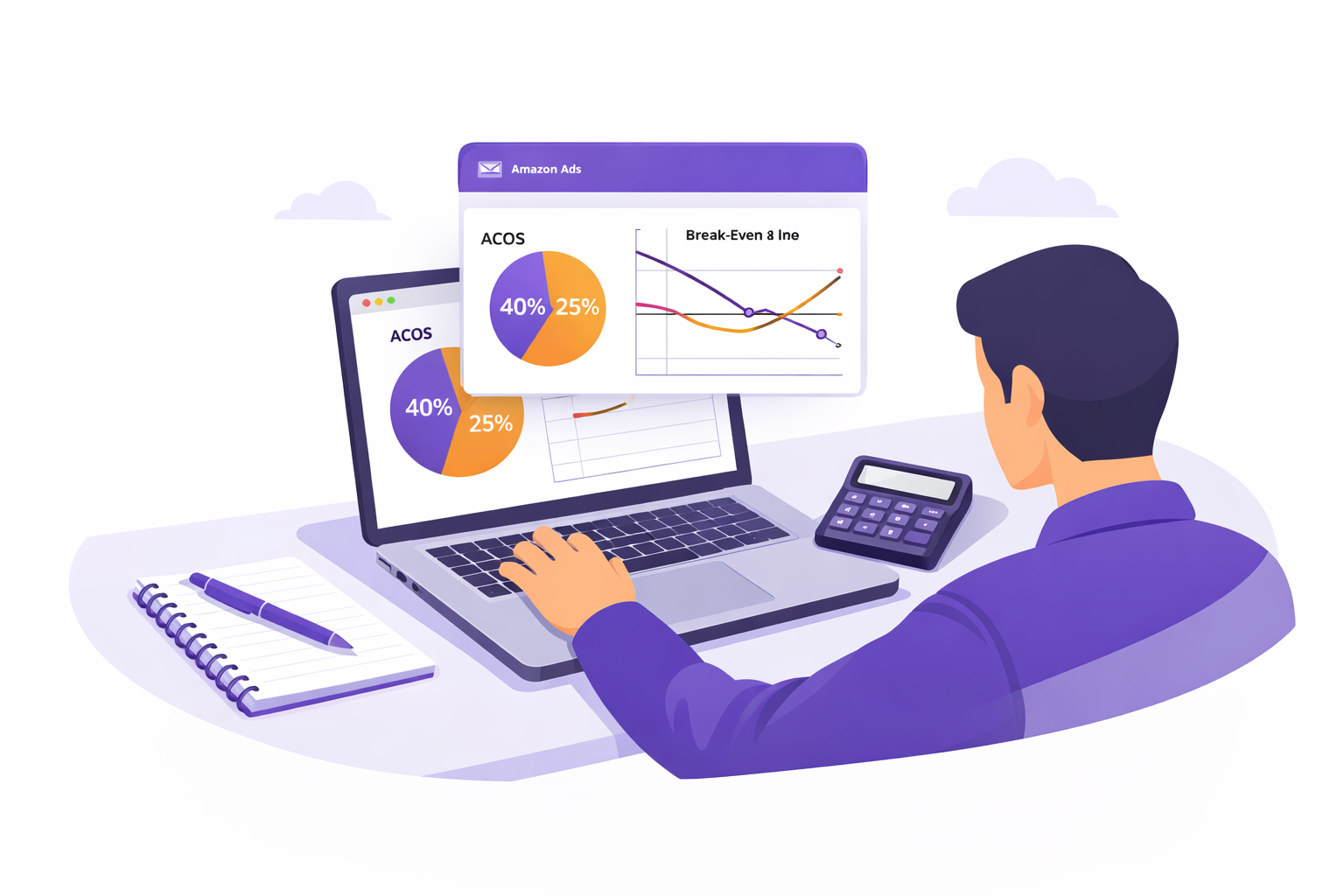
They see a 40% ACOS and think, "I'm getting sales!"
But if their break-even is 25%, that 40% ACOS means they're paying $4 in ads to earn $2.50 in royalty. That's a $1.50 loss per book sold.
2. They Confuse Revenue with Profit
Amazon's dashboard shows you sales revenue. It's tempting to celebrate seeing "$500 in ad-attributed sales!"
But if you spent $300 on ads to generate those sales, and your royalty was only $125, you didn't make $200 profit. You lost $175.
3. They Chase Vanity Metrics
Impressions. Clicks. Even sales.
None of these matter if you're not profitable. I've seen authors celebrate "1,000 sales from ads!" while losing $500 in the process.
4. Low-Royalty Books Make Profitability Harder
Low-content books and cheap ebooks have razor-thin margins. A $6.99 low-content book might only net you $1.50 in royalty.
Your break-even ACOS? Around 21%.
That's an incredibly tight margin. One expensive click can wipe out multiple sales worth of profit.
Understanding ACOS vs. Actual Profit
ACOS (Advertising Cost of Sale) is Amazon's default metric. It tells you what percentage of your sales revenue went to advertising.
ACOS = (Ad Spend ÷ Ad Revenue) × 100
But here's the problem: ACOS doesn't tell you if you're profitable.
Example: The Deceptive 30% ACOS
Let's say you have:
- Book price: $14.99
- Royalty: $5.25 (35% rate for paperback)
- Ad spend: $45
- Ad-attributed sales: 10 books
- Ad revenue: $149.90
Your ACOS: ($45 ÷ $149.90) × 100 = 30%
That sounds reasonable, right? But let's check the actual profit:
- Total royalties earned: 10 × $5.25 = $52.50
- Ad spend: $45.00
- Actual profit: $7.50
You made $7.50 profit. That's 75 cents per book sold.
Now imagine your ACOS creeps up to 35%:
- Ad spend would be: $52.47
- Total royalties: $52.50
- Actual profit: $0.03
You basically broke even. And at 36% ACOS? You're losing money.
The ACOS Table You Actually Need
| Book Price | Royalty Rate | Your Royalty | Break-Even ACOS |
|---|---|---|---|
| $2.99 eBook | 70% | $2.09 | 70% |
| $4.99 eBook | 70% | $3.49 | 70% |
| $9.99 eBook | 70% | $6.99 | 70% |
| $6.99 Paperback | 60% margin | $1.50 | 21% |
| $9.99 Paperback | 60% margin | $2.50 | 25% |
| $14.99 Paperback | 60% margin | $5.25 | 35% |
| $19.99 Paperback | 60% margin | $7.00 | 35% |
Note: Paperback royalties vary based on page count and printing costs. Always calculate your exact royalty before setting ad budgets.
Real-World Example: Low-Content Book vs. Fiction Novel
Let's compare two very different books and their advertising viability.
Book A: Low-Content Journal
- Price: $6.99
- Page count: 120 pages
- Printing cost: ~$2.50
- Royalty: $1.50 (approximately)
- Break-even ACOS: 21%
With a 21% break-even ACOS, you have almost no margin for error.
If the average cost-per-click in your category is $0.30, and your conversion rate is 10% (which is actually quite good), your cost per sale is $3.00.
That's $3.00 in ad spend to earn $1.50 in royalty. You're losing $1.50 per sale.
To break even with that CPC and conversion rate, you'd need a conversion rate of 20% or higher. That's extremely rare.
Verdict: Advertising low-content books is very difficult to make profitable unless you have exceptional conversion rates or very low CPCs.
Book B: Fiction Novel
- Price: $4.99 (eBook)
- Royalty rate: 70%
- Delivery fee: ~$0.10
- Net royalty: $3.39
- Break-even ACOS: 68%
Now you have room to breathe.
With the same $0.30 CPC and 10% conversion rate, your cost per sale is still $3.00. But your royalty is $3.39.
You're making $0.39 profit per sale.
Not amazing, but it's profit. And if you can improve your conversion rate or find cheaper keywords, profitability increases quickly.
Verdict: Higher-priced ebooks with 70% royalty rates give you much more advertising flexibility.
Use the KDP Break-Even Calculator Before Running Ads
Before you spend a single dollar on Amazon Ads, you need to know your numbers.
Here's how to calculate your break-even point step by step:
Step 1: Calculate Your Exact Royalty
Use our KDP Earnings Calculator to find your per-book royalty.
Example inputs:
- Book format: Paperback
- Price: $12.99
- Page count: 200 pages
- Marketplace: US
Result: Your royalty is approximately $3.90 per sale.
Step 2: Calculate Your Break-Even ACOS
Break-Even ACOS = (Royalty ÷ Price) × 100
For our example:
- Break-Even ACOS = ($3.90 ÷ $12.99) × 100 = 30%
This means you can spend up to 30% of your book's price on ads and still break even.
Step 3: Determine Your Target ACOS
Your target ACOS should be below your break-even ACOS. How much below depends on your goals:
- Aggressive growth: Target ACOS 5% below break-even (25% in our example)
- Moderate profit: Target ACOS 10% below break-even (20% in our example)
- Conservative profit: Target ACOS 15% below break-even (15% in our example)
Step 4: Calculate Maximum Cost Per Click
This is where most authors never go, but it's crucial.
Maximum CPC = (Target ACOS × Price × Conversion Rate)
Assuming a 10% conversion rate and 20% target ACOS:
- Maximum CPC = (0.20 × $12.99 × 0.10) = $0.26
If you bid higher than $0.26 per click, you'll likely exceed your target ACOS.
Step 5: Set Your Daily Budget Based on Reality
Now you can set a realistic daily budget:
Daily budget = Maximum CPC × Expected daily clicks
If you want about 50 clicks per day at $0.26 per click:
- Daily budget = $0.26 × 50 = $13/day
At a 10% conversion rate, that's 5 sales per day, generating $19.50 in royalties against $13 in ad spend = $6.50 daily profit.
The Break-Even ACOS Cheat Sheet
Here's a quick reference based on common book types:
| Book Type | Typical Price | Typical Royalty | Break-Even ACOS | Difficulty |
|---|---|---|---|---|
| Low-content (thin) | $5.99-$7.99 | $1.00-$2.00 | 15-25% | Very Hard |
| Low-content (thick) | $9.99-$12.99 | $2.50-$4.00 | 25-31% | Hard |
| Paperback fiction | $12.99-$16.99 | $3.50-$5.50 | 27-32% | Moderate |
| eBook (70% rate) | $2.99-$9.99 | $2.00-$6.90 | 65-70% | Easier |
| Hardcover | $24.99-$34.99 | $5.00-$10.00 | 20-29% | Moderate |
The "Difficulty" column reflects how challenging it is to maintain profitable ads at scale. eBooks at 70% royalty rate have the highest margins, making advertising much more forgiving.
Common Beginner Mistakes (And How to Avoid Them)
Mistake #1: Starting Ads Before Knowing Your Numbers
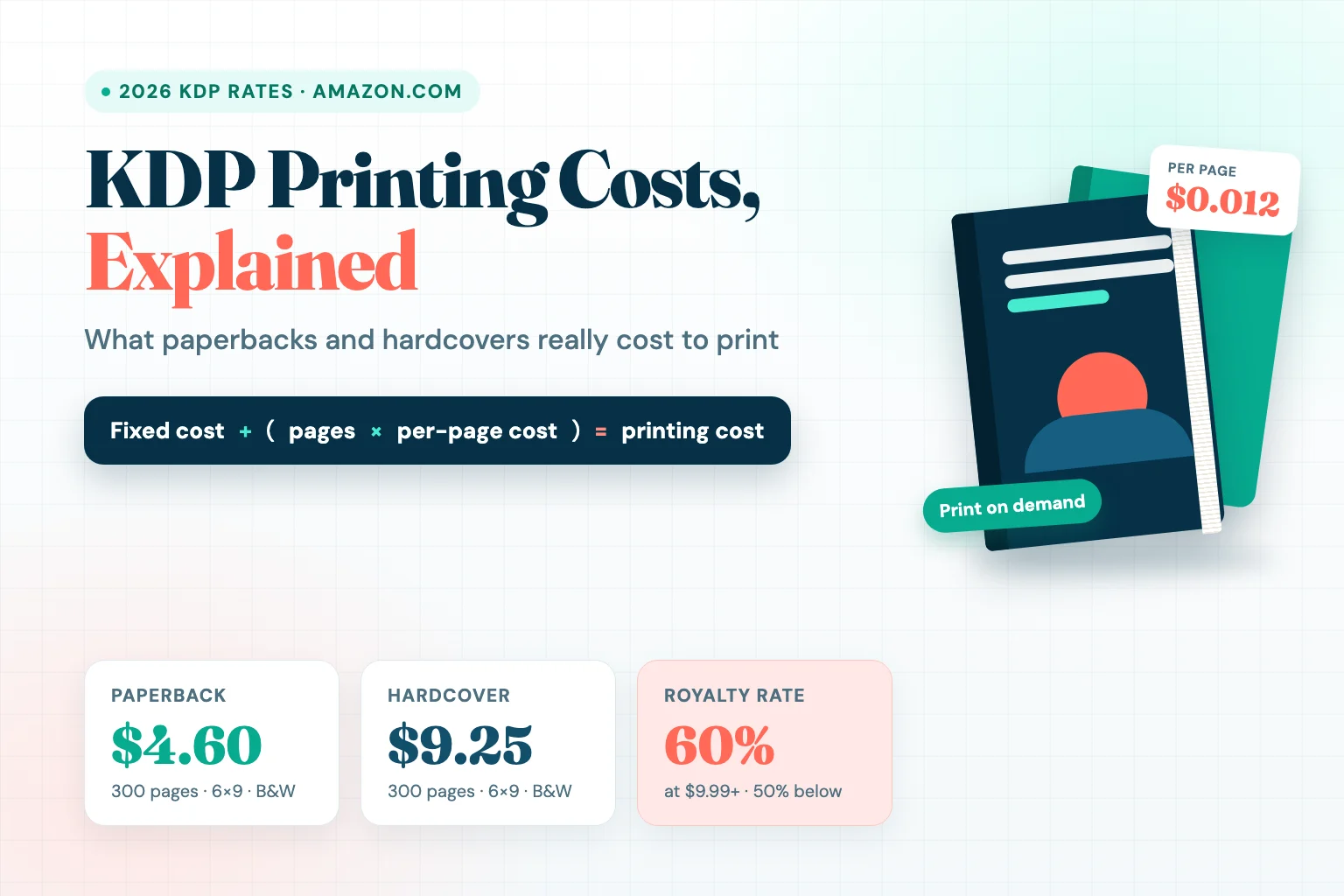
The fix: Before creating any campaign, calculate your exact royalty using our earnings calculator and determine your break-even ACOS.
Mistake #2: Using Amazon's Suggested Bids
Amazon's suggested bids are designed to win impressions, not to make you money. They're often 2-3x higher than profitable bids.
The fix: Calculate your maximum CPC based on your target ACOS and conversion rate. Start at 50% of Amazon's suggested bid and adjust from there.
Mistake #3: Running Ads on Books with Weak Conversion
Ads amplify what's already working. If your book page doesn't convert organic traffic, ads won't fix that.
The fix: Check your conversion rate in KDP reports before advertising. If it's below 5%, fix your cover, blurb, or look-inside first.
Mistake #4: Not Tracking ACOS by Campaign
Your average ACOS across all campaigns is meaningless. Some campaigns might be profitable while others drain your budget.
The fix: Review each campaign individually. Pause or optimize campaigns exceeding your break-even ACOS.
Mistake #5: Expecting Immediate Results
Amazon's attribution window is 14 days. A click today might result in a sale next week.
The fix: Wait at least 2 weeks before judging a new campaign's performance. Early data is too noisy to make decisions.
Mistake #6: Ignoring Organic Sales Lift
Ads don't just generate direct sales. They improve your BSR, which increases organic visibility, which generates free sales.
The fix: Track your total sales (not just ad-attributed) during advertising periods. Some authors accept break-even ACOS because the organic lift makes it profitable overall.
Mistake #7: Advertising the Wrong Books
Some books simply aren't advertising-viable. Low royalty + competitive keywords = guaranteed losses.
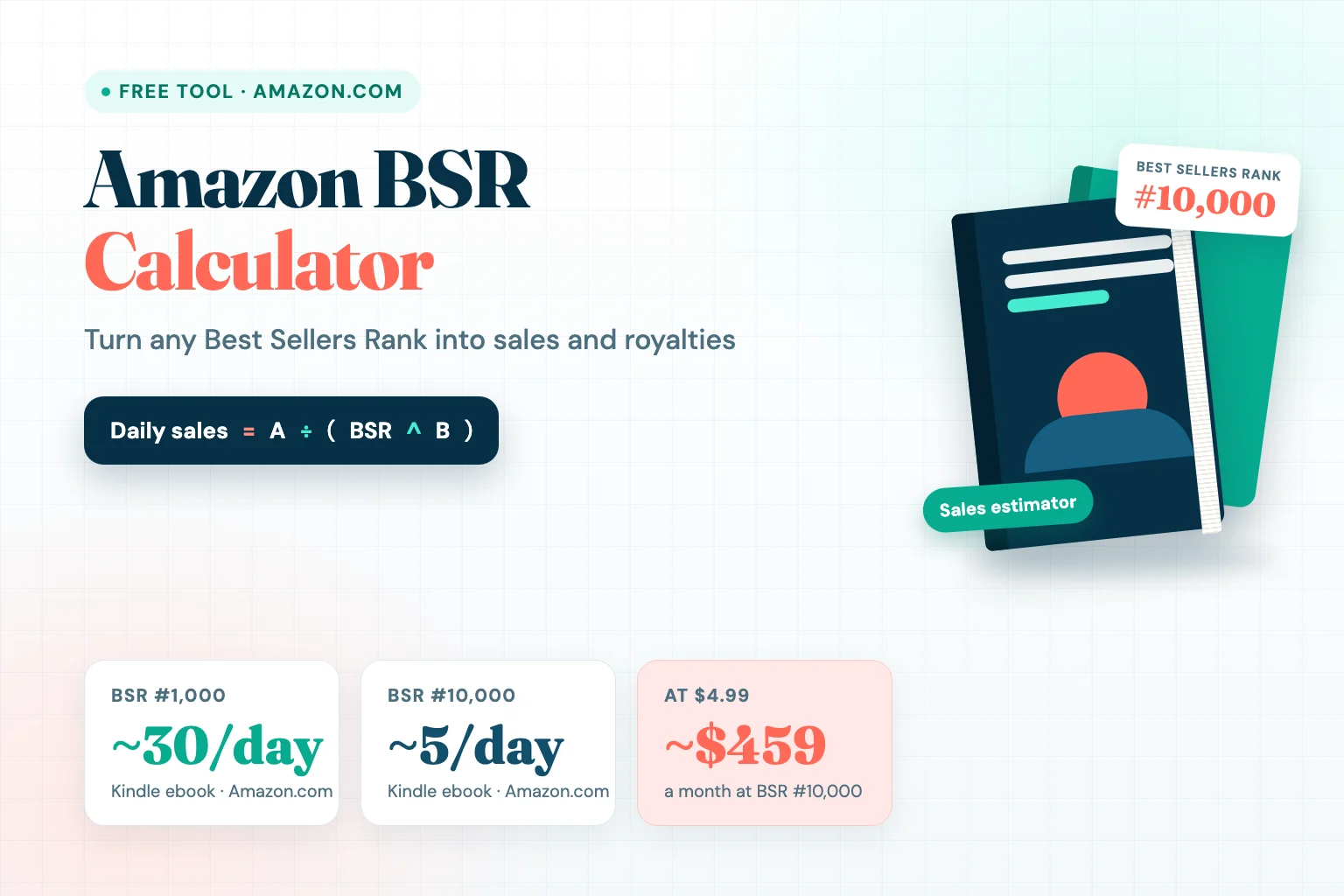
The fix: Use our BSR to Sales Calculator to research competitors. If books in your niche have high BSRs (low sales), the market might be too small to justify ad spend.
When Should You NOT Run Amazon Ads?
Sometimes the smart move is not advertising at all. Consider skipping ads if:
- Your break-even ACOS is below 20% — The margin is too thin for most categories
- Your book has no reviews — Conversion rates will be poor
- Your cover isn't competitive — You'll pay for clicks that don't convert
- The niche CPCs exceed your maximum — Some categories are too expensive
- You're unwilling to lose money learning — The first few weeks often aren't profitable
Better alternatives for these situations:
- Focus on building reviews
- Invest in a better cover
- Build an email list for free launches
- Write more books in series to increase customer lifetime value
The Profitable Advertising Mindset
Here's the mental shift that separates profitable advertisers from money losers:
Unsuccessful mindset: "I'm spending $X on ads. I hope I get sales!"
Successful mindset: "My break-even ACOS is 30%. I'll bid no more than $0.25 per click to target 20% ACOS. At 10% conversion, I expect to profit $1.40 per sale."
The second author has done the math. They know exactly what "success" looks like before spending anything.
Action Steps Before Your Next Campaign
Before you touch Amazon's advertising console:
- Calculate your exact per-book royalty — Use our KDP Earnings Calculator
- Determine your break-even ACOS — Royalty ÷ Price × 100
- Set your target ACOS — 5-15% below break-even
- Calculate maximum CPC — Based on realistic conversion rates
- Set daily budget — Based on your maximum CPC and desired volume
Run the numbers. Know your limits. Then advertise.
The math isn't complicated. But skipping it is expensive.
FAQs About KDP Advertising Break-Even
What's a good ACOS for Amazon book ads?
"Good" depends entirely on your break-even point. For a $9.99 paperback with 25% break-even ACOS, anything under 25% is good. For a $4.99 ebook at 70% royalty, you have much more flexibility. There's no universal "good" number.
How much should I budget for Amazon ads as a new author?
Start with $5-$10 per day for at least 2 weeks. This gives you enough data to evaluate performance without risking significant money. Scale up only after confirming profitability.
Can I make money advertising low-content books?
It's difficult but possible. You need either very low CPCs (under $0.15), very high conversion rates (15%+), or higher-priced books ($12.99+). Most low-content books are better promoted through organic methods.
Why is my ACOS so high?
High ACOS typically means one of three things: your bids are too high, your conversion rate is too low, or you're targeting overly competitive keywords. Start by lowering bids and analyzing which keywords actually convert.
Should I use automatic or manual campaigns?
Start with automatic campaigns for 2 weeks to gather keyword data. Then use that data to build targeted manual campaigns with controlled bids. Most profitable advertisers use both strategically.
How long before Amazon ads become profitable?
Typically 2-4 weeks of optimization. The learning period includes identifying profitable keywords, adjusting bids, and improving targeting. Expect to lose money or break even initially while gathering data.
👉 Calculate your real Amazon KDP royalties here — our free calculator shows ebook, paperback & hardcover earnings instantly.
📊 INTERNAL LINKING MAP
More tools and guides to maximize your KDP profits:
Topics
Ready to Run the Numbers?
Put this knowledge into action. Calculate your potential royalties before you publish.