
KDP Royalty Calculator: Master Pricing Psychology & Profit Optimization
Learn how to use a KDP royalty calculator strategically. Discover pricing psychology, competitor analysis techniques, and profit optimization strategies to maximize your Amazon book earnings.
Why Every KDP Author Needs a Royalty Calculator
Publishing a book on Amazon KDP without calculating your royalties is like opening a restaurant without knowing your food costs. You might get lucky—or you might lose money on every sale.
A KDP royalty calculator isn't just a number-cruncher. Used strategically, it becomes a profit optimization tool that helps you:
- Find your optimal price point for maximum profit
- Analyze competitor pricing strategies
- Make data-driven publishing decisions
- Avoid common pricing mistakes that cost authors thousands
This guide goes beyond basic calculations. We'll explore the psychology behind book pricing, teach you how to reverse-engineer competitor strategies, and show you how to optimize every book in your catalog for maximum profitability.
How KDP Royalties Actually Work
Before diving into strategy, let's ensure you understand the mechanics. Amazon KDP calculates royalties differently based on book format.
Ebook Royalty Structure
Amazon offers two royalty options for Kindle ebooks:
| Royalty Rate | Price Range | Delivery Fee | Best For |
|---|---|---|---|
| 35% | $0.99 – $200.00 | None | Low-priced books, short reads |
| 70% | $2.99 – $9.99 | ~$0.15/MB | Standard-length books |
The 70% trap: Many authors assume 70% is always better. But delivery fees can eat into profits, especially for image-heavy books or longer manuscripts.
Example calculation:
A 5MB ebook priced at $2.99:
- 70% option: ($2.99 × 70%) − $0.75 delivery = $1.34
- 35% option: $2.99 × 35% = $1.05
A 0.5MB ebook priced at $2.99:
- 70% option: ($2.99 × 70%) − $0.08 delivery = $2.01
- 35% option: $2.99 × 35% = $1.05
The 70% rate almost always wins—but the margin varies significantly based on file size.
Print Book Royalty Structure
Print books (paperback and hardcover) use a different formula:
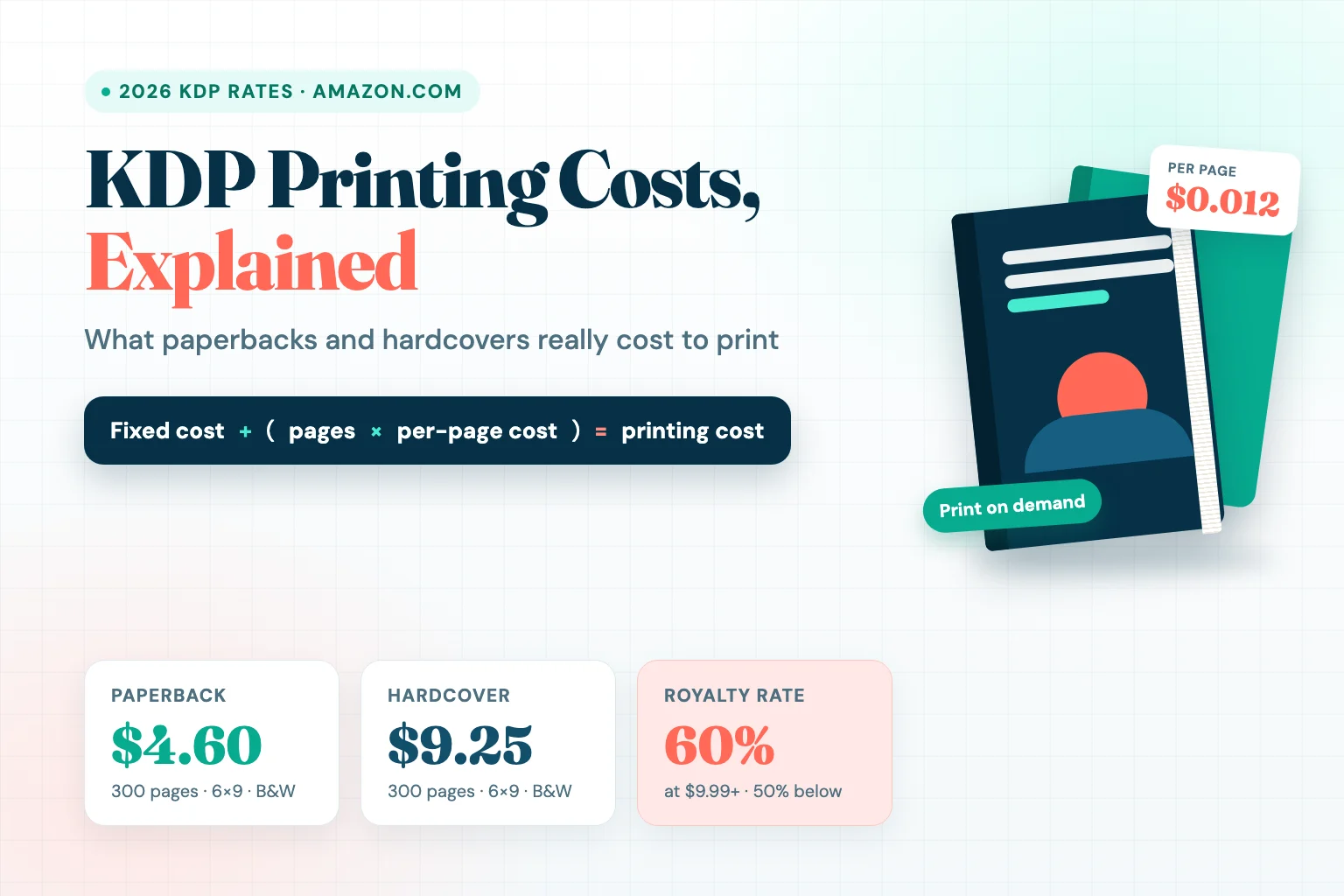
(List Price × 60%) − Printing Cost = Your Royalty
Printing costs depend on:
- Page count
- Interior type (black & white vs. color)
- Trim size
- Marketplace
Example: A 150-page black & white paperback at $12.99:
- Gross royalty: $12.99 × 60% = $7.79
- Printing cost: ~$3.08
- Net royalty: $4.71
👉 Calculate your exact royalties with our free calculator.
The Psychology of Book Pricing
Pricing isn't just math—it's psychology. The price you set communicates value, influences purchase decisions, and positions your book in the market.
Price Anchoring
Readers unconsciously compare your book's price to similar titles. This is called price anchoring.
Strategic application:
- If competitors price at $14.99, pricing at $12.99 feels like a deal
- If competitors price at $9.99, pricing at $14.99 signals "premium quality"
- Pricing far below market rate ($4.99 when others are $14.99) can backfire—readers may assume lower quality
Psychological Price Points
Certain prices trigger stronger purchase responses:
| Price | Psychology | Best Use Case |
|---|---|---|
| $0.99 | Impulse buy, low risk | New author, series starter |
| $2.99 | Still an impulse, feels like value | Novellas, short non-fiction |
| $4.99 | Entry-level "real" book | Standard length fiction/non-fiction |
| $9.99 | Maximum Kindle royalty efficiency | Established authors, premium content |
| $12.99 | Professional, serious content | Business books, specialized guides |
| $19.99+ | Expert/authority positioning | Comprehensive guides, textbooks |
The Charm Pricing Effect
Prices ending in .99 convert better than round numbers. This is called charm pricing.
- $9.99 feels significantly cheaper than $10.00
- $14.99 triggers less resistance than $15.00
- The brain processes the leftmost digit first
Always use .99 endings unless you're deliberately positioning as premium (where $15.00 can signal exclusivity).
Loss Aversion in Pricing
Readers experience losses more intensely than equivalent gains. This means:
- A $5 book that disappoints hurts more than a $5 book that delights pleases
- Higher prices require proportionally more value demonstration
- Reviews and look-inside features become more important at higher price points
Implication: If you price aggressively ($19.99+), your book's perceived value (cover, description, reviews) must justify the investment upfront.
Competitor Analysis: Reverse-Engineering Profitable Pricing
The most successful KDP publishers don't guess at pricing. They systematically analyze what's working in their niche.
Step 1: Identify Your True Competitors
Don't compare your book to bestsellers with 10,000 reviews. Find books that match:
- Similar page count
- Similar publication date (last 6-12 months)
- Same categories/keywords
- Comparable review count (within 2x of your expected reviews)
These are your true competitors—books your potential readers are choosing between.
Step 2: Create a Competitor Pricing Matrix
Build a spreadsheet with:
| Book Title | Price | Page Count | BSR | Reviews | $/Page | Royalty Est. |
|---|---|---|---|---|---|---|
| Competitor A | $12.99 | 180 | 45,000 | 87 | $0.072 | $4.71 |
| Competitor B | $9.99 | 120 | 25,000 | 156 | $0.083 | $3.15 |
| Competitor C | $14.99 | 220 | 65,000 | 42 | $0.068 | $5.94 |
Key metrics to track:
- Price per page: Reveals value perception benchmarks
- BSR relative to price: Higher prices with strong BSR indicate value justification
- Review count to price ratio: More reviews support higher prices
Step 3: Calculate Competitor Royalties
Use a royalty calculator to estimate what competitors are earning per sale. This reveals:
- Which pricing strategies are sustainable
- The profit floor in your niche
- Opportunities to optimize above the market
Example insight: If most competitors are earning $3-4 per sale but one outlier earns $6 with similar sales rank, study their positioning—they've found a pricing advantage.
Step 4: Identify the Pricing Gap
Look for underserved price points:
- If everyone prices at $14.99, test $11.99 or $17.99
- If the market clusters around $9.99, premium positioning at $19.99 might differentiate
- Empty price zones often represent opportunity
Profit Optimization Strategies
Now let's turn analysis into action. Here are proven strategies to maximize your KDP earnings.
Strategy 1: The Royalty Sweet Spot Method
For each book, there's a price that maximizes total profit—not per-sale royalty, but royalty × volume.
How to find it:
- Calculate royalty at multiple price points ($9.99, $12.99, $14.99, $17.99)
- Estimate conversion rate change (typically -10-15% per $3 price increase)
- Model total revenue at each price
- Choose the point where royalty × estimated sales peaks
Example calculation:
| Price | Royalty | Est. Conversion | Revenue Index |
|---|---|---|---|
| $9.99 | $3.15 | 100% | 315 |
| $12.99 | $4.71 | 85% | 400 |
| $14.99 | $5.94 | 70% | 416 |
| $17.99 | $7.39 | 55% | 406 |
In this example, $14.99 maximizes total revenue despite lower conversion than $12.99.
Strategy 2: Format Stacking
Publish multiple formats and price them strategically to drive buyers toward your highest-margin option.
Typical pricing stack:
| Format | Price | Royalty | Strategy |
|---|---|---|---|
| Ebook | $4.99 | $3.34 | Entry point, builds reviews |
| Paperback | $14.99 | $5.94 | Primary profit driver |
| Hardcover | $24.99 | $8.50 | Premium option, anchors paperback |
The hardcover makes the paperback look like a deal. The ebook captures price-sensitive readers who might review.
Strategy 3: Price Testing Through Promotions
You can't A/B test prices directly on Amazon, but you can:
- Run a limited-time price promotion
- Track BSR and sales rank change
- Measure unit sales before, during, and after
- Calculate revenue at each price point
Testing framework:
- Week 1-2: Baseline at original price
- Week 3: Promotional price (20-30% reduction)
- Week 4: Return to original price
- Compare total revenue and rank sustainability
Strategy 4: Seasonal Price Optimization
Many niches have seasonal demand patterns. Optimize pricing accordingly:
- High season: Price at premium (higher demand absorbs price increase)
- Low season: Price competitively or run promotions to maintain velocity
- Gift-giving periods: Premium pricing on hardcovers and gift-appropriate titles
Example: A gardening book might price at $16.99 from March-June (peak demand) and $12.99 from October-February (low season).
Strategy 5: Catalog-Level Optimization
If you have multiple books, optimize at the catalog level:
- Loss leader books: Price book 1 of a series low to acquire readers
- Profit maximizers: Price back-catalog standalones for maximum royalty
- Bundle pricing: Create box sets priced just below the sum of individual books
Series strategy:
| Book | Price | Royalty | Purpose |
|---|---|---|---|
| Book 1 | $2.99 | $2.01 | Reader acquisition |
| Book 2-5 | $4.99 | $3.34 | Standard profit |
| Box Set 1-3 | $9.99 | $6.94 | Value offer, higher revenue |
Common Pricing Mistakes to Avoid
Mistake 1: Pricing Based on Effort
You spent 500 hours writing your book. That doesn't mean readers will pay $49.99.
Reality: Readers pay based on perceived value and market alternatives, not your labor.
Mistake 2: Ignoring Printing Costs
A $9.99 paperback with 400 pages might net you only $0.50 after printing costs.
Solution: Always calculate net royalty, not list price, when setting prices.
Mistake 3: Racing to the Bottom
Chronic underpricing to "beat" competitors destroys profit margins and signals low quality.
Better approach: Compete on value, positioning, and marketing—not just price.
Mistake 4: Set It and Forget It
Markets evolve. Competitors change prices. Seasons shift demand.
Best practice: Review pricing quarterly using fresh competitor analysis.
Mistake 5: Ignoring Format Economics
Ebook and paperback pricing should be independent calculations based on their own cost structures.
Common error: Pricing paperback at 2x ebook. Better to calculate each format's optimal price independently.
Using a Royalty Calculator Strategically
A royalty calculator becomes powerful when you use it systematically:
Pre-Publication Workflow
- Finalize page count and interior specifications
- Research competitor pricing in your category
- Calculate royalties at 4-5 price points
- Model revenue scenarios with estimated conversion rates
- Choose launch price based on optimization, not guessing
Monthly Optimization Review
- Pull sales data from your KDP dashboard
- Recalculate break-even based on actual ad spend
- Check competitor prices for market shifts
- Test price adjustments on underperforming titles
- Document results for future decision-making
New Book Pricing Checklist
Before pricing any new book:
- Calculated royalty at minimum viable price
- Calculated royalty at maximum market price
- Identified competitor pricing cluster
- Determined format-specific margins
- Selected price based on data, not instinct
👉 Run your calculations now with our free KDP royalty calculator.
The Profit Optimization Mindset
The difference between struggling KDP publishers and profitable ones often comes down to mindset:
Struggling publishers:
- Price once and forget
- Copy competitor prices without analysis
- Optimize for per-sale royalty instead of total profit
- Ignore format-specific economics
Profitable publishers:
- Treat pricing as an ongoing optimization problem
- Use data to inform every pricing decision
- Model scenarios before launching
- Test and iterate based on real sales data
Your royalty calculator is the foundation. The strategies in this guide are the system. Together, they transform pricing from guesswork into a competitive advantage.
Take Action Today
Don't let another book launch without proper royalty analysis:
- Calculate your royalties using our free tool
- Build a competitor pricing matrix for your top category
- Identify your optimal price point using the sweet spot method
- Review and optimize existing titles in your catalog
The authors who win on KDP are the ones who treat publishing like a business—and that starts with knowing your numbers.
Frequently Asked Questions
What is a KDP royalty calculator?
A KDP royalty calculator is a tool that calculates your net earnings from Amazon Kindle Direct Publishing books. It accounts for list price, royalty rate, printing costs (for print books), and delivery fees (for ebooks) to show your actual profit per sale.
How often should I recalculate my book royalties?
Review your pricing and royalties quarterly, or whenever significant market changes occur (new major competitor, seasonal shifts, Amazon fee changes). Active publishers should also recalculate after any promotional period.
What's the most profitable price for a KDP paperback?
There's no universal answer—it depends on your page count, trim size, and competitive landscape. However, most profitable paperbacks fall between $12.99-$17.99, where you balance strong royalties with acceptable conversion rates.
Should I price my ebook at $0.99 to get more sales?
Only strategically—such as for series starters or limited promotions. Chronic $0.99 pricing signals low value, attracts deal-seekers who won't buy your other books, and generates minimal profit. The $2.99-$4.99 range typically works better for sustainable businesses.
How do I know if my book is priced too high?
Watch for: declining sales rank over time, poor conversion from page views to purchases, competitor books at lower prices maintaining better ranks. If these signals appear, test a lower price point for 2-3 weeks and compare results.
Does Amazon ever change royalty rates?
Amazon adjusts printing costs periodically (typically annually). Ebook royalty percentages (35%/70%) have remained stable, but delivery fees may change. Always use current rates in your calculations.
What's the difference between gross and net royalty?
Gross royalty is your percentage of the list price (60% for print, 35%/70% for ebooks). Net royalty is what you actually receive after deducting printing costs and delivery fees—this is the number that matters.
Related Resources
- How Much Money Can You Make on Amazon KDP?
- Understanding Amazon BSR and Sales
- Amazon KDP vs IngramSpark Comparison
- BSR to Sales Calculator
👉 Calculate your real Amazon KDP royalties here — our free calculator shows ebook, paperback & hardcover earnings instantly.
Topics
Ready to Run the Numbers?
Put this knowledge into action. Calculate your potential royalties before you publish.